Skip to content


Homeowners often ask whether they should oversize their solar systems. The motivation is usually to save money and gain energy independence, but oversizing isn’t always the best move. The right choice depends on your current and future energy needs, local utility rules, and the total cost of the system.
Net metering can give you credits for extra energy you produce, but those credits rarely arrive as a cash payment — they most often reduce your bill or are handled under specific export-credit rules that vary by utility and state. An oversized system can delay your payback if you don’t have a reliable way to use or store the extra power (for example, with a battery or planned electric vehicle charging).
Key Takeaways
- Oversizing a solar panel system does not guarantee maximum savings; export limits and non-cash crediting can reduce financial benefit.
- Utility policies on excess solar production and net metering are decisive—check your local tariff before adding extra panels.
- Oversized solar systems have higher upfront costs, which lengthens the time to recoup your investment unless local incentives or SREC markets strongly favor larger arrays.
- Accurately determining solar panel requirements (usage, roof space, panel rating, and peak sun hours) helps optimize system size for both today’s needs and likely future growth.
- If you plan a home expansion or an electric vehicle, a slightly larger system plus a battery can make sense; otherwise, size to realistic near-term energy use.
- Follow the National Electric Code guidance (often referenced as the “120% rule”) and confirm with your utility and installer how it is applied locally to avoid interconnection barriers.
- Tax credits and SREC income can tilt the balance toward a bigger system in some states — always verify eligibility and projected revenue for your location.
Understanding the Basics of Solar Panel Sizing
Solar panel sizing is the foundation of an efficient solar energy system. Whether you’re a homeowner or business owner, the right system size and number of panels determine how much of your electricity needs you can meet, how quickly you recoup cost, and how much roof space the array will require.
What Determines Your Solar Panel Requirements?
Your required solar capacity depends on a few key inputs: your current electricity usage (kWh), average daily peak sun hours at your location, the wattage and real-world output of the panels you choose, inverter and system losses, and available roof space and orientation. Each of these factors changes the final panel count and the array size you’ll need.
Matching Solar Panel Quantity with Usage Patterns
 Sizing a system is about aligning daily energy usage with expected solar output. More efficient panels or higher panel wattage reduce the number of panels required for the same annual production; conversely, lower-efficiency panels or limited roof space increase required panel count.
Simple worked example (use this as a template):
- Start with monthly usage: 900 kWh → daily average = 900 ÷ 30 = 30 kWh/day.
- Estimate peak sun hours (example: 4.5 hours/day in many U.S. locations).
- Required DC array output = daily kWh ÷ peak sun hours = 30 kWh ÷ 4.5 h ≈ 6.67 kW (6,670 W).
- Account for system losses (inverter, wiring, soiling). Use a derate factor (typical 0.75–0.85). With 0.80 derate: needed nameplate = 6,670 ÷ 0.80 ≈ 8,337 W.
- Choose panel wattage to get panel count: with 370W panels → 8,337 ÷ 370 ≈ 23 panels; with 250W panels → 8,337 ÷ 250 ≈ 34 panels.
Note: the example above uses common assumptions—you should adjust peak sun hours, derate factor, and panel wattage to your location and chosen equipment.
Consider this quick reference of how panel wattage affects count for representative monthly usages:
| Home TypeMonthly Energy Usage (kWh)Approx. Panels (250W)Approx. Panels (370W) | |||
| Small Home (Temperate) | 200 | ~10 | ~7 |
| Average U.S. Home | 900 | ~25 | ~17 |
| Large Home (Warm) | 2000 | ~55 | ~37 |
These figures are illustrative: they assume typical peak sun hours and include a conservative derate for real-world output. When planning, explicitly document your assumed peak sunlight hours, panel rating and wattage, roof usable space, and inverter rating so you can verify the panel size and array will meet your goals without causing excessive clipping.
Considering Net Metering and Utility Policies
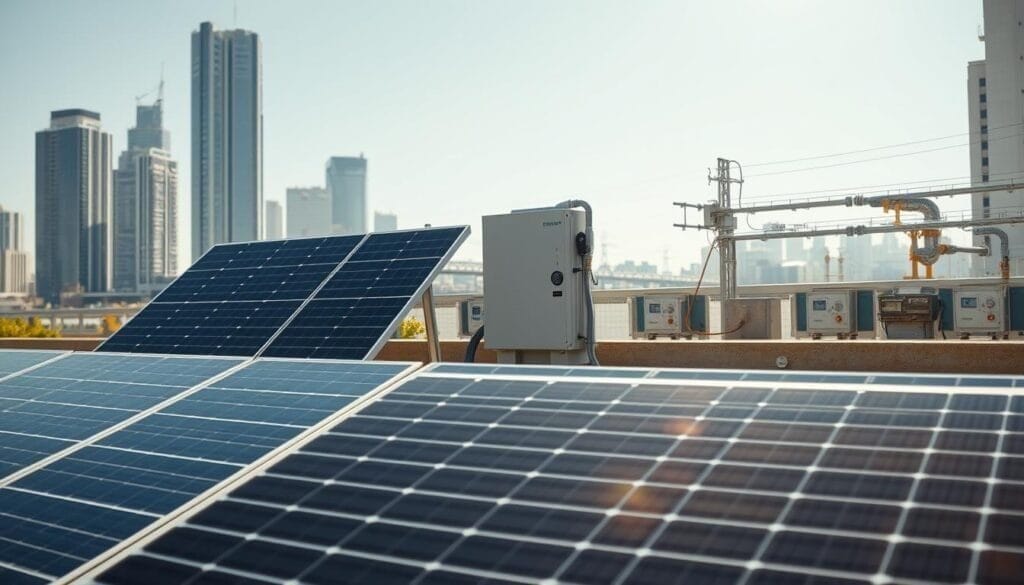
When looking into solar panel installation considerations, it’s essential to understand how net metering and utility export policies will affect your project. Net metering lets homeowners send excess electricity back to the grid in exchange for credits, but the value and treatment of those credits vary widely by state and by utility tariff.
Some states and utilities still offer full retail credit for exported electricity, which makes adding extra solar panels more attractive. For example, historically New Jersey and parts of Florida have provided strong crediting that materially shortens payback periods. However, these outcomes depend on current local incentives, retail electricity rates, and whether SREC markets are available — all of which change over time.
Conversely, several utilities have moved to net billing or reduced export-credit programs (California’s Net Billing 3.0 being a widely discussed example), which can value exported energy at a fraction of retail. That change reduces the financial case for excess solar capacity and means homeowners should run a local tariff-specific model before adding panels. For recent policy updates in individual states, see the linked EnergySage article on North Carolina as an example of how rules can change: https://www.energysage.com/blog/north-carolina-new-net-metering-policy/
| State/PolicyCredit SystemTypical Impact on Payback | ||
| New Jersey (Net Metering) | Full retail credit (varies by utility) | Tends to shorten payback in strong-incentive areas |
| California (Net Billing 3.0) | Export valued below retail | Reduces value of exported production versus prior net metering |
| Florida (Net Metering & programs) | Full retail or competitive export rates (varies) | Competitive payback depending on local rates and incentives |
To capture value from exported energy, homeowners should:
- Check your utility tariff and current net metering/export rules (contact the utility or review the state PUC/DSIRE listings).
- Model payback using your actual electricity rate, projected retail escalation, and local incentives—don’t rely on national averages.
- Consider adding a battery if export credits are low: storage lets you use more solar production on-site during peak-priced hours instead of exporting at low credit rates.
Because utility policies and state incentives change, act on up-to-date local information. That will tell you whether adding more panels or sizing a system closer to current energy consumption makes the most financial sense for your roof, budget, and long-term goals.
Should I Get More Solar Panels Than I Need?
Deciding whether to install extra solar panels depends on your goals, timeline, and local economics. Installing more panels than your current needs can create future flexibility—supporting planned electric vehicle charging, a home addition, or a battery system—but it also raises upfront cost and may not pay back quickly unless local incentives or export-credit rules are favorable.
Benefits of Excess Solar Panel Capacity

Extra capacity can increase on-site production during sunny periods, improve resilience, and create potential revenue through incentive programs like SRECs in markets where those credits still exist. Studies have also shown that solar panels can increase a home’s resale value, though the exact percentage varies by market and study methodology. In locations with strong sunlight and attractive export credits, adding a few extra panels can shorten the time to full on-site renewable coverage.
Drawbacks of Overestimating Solar Panel Needs
Oversizing has downsides: higher installation costs, increased permitting and interconnection scrutiny, and the risk that excess production will be exported at low credit rates or not credited at all. Instead of a single dollar figure, use a cost range tied to system size—for example, residential systems often vary widely in price depending on local labor and equipment costs (commonly expressed as $/W). If you don’t plan to stay in your home long, or if your utility values exports poorly, the extra panels may not deliver the expected financial return.
| ConsiderationBenefitDrawback | ||
| Financial return from incentives | Can be substantial where SRECs, state rebates, or high export credits exist | Incentives and export rates vary; added cost per watt may not be recovered everywhere |
| Home value | May increase resale value in many markets | Value depends on local demand and buyer awareness; short ownership horizon reduces benefit |
| Energy production | Maximizes output on sunny days and supports future loads | Excess energy may be exported at low credit or require storage to capture full value |
Decision checklist (quick): 1) How long will you stay in the home? 2) Do you plan an EV or major appliance additions within 2–5 years? 3) What does your utility pay for exports? 4) How much usable roof space and what panel wattage can you install? Answering these will clarify whether adding panels or sizing closer to current usage makes the most sense.
If you’re leaning toward extra capacity, size conservatively—add a small buffer (1–20% depending on goals) and consider pairing the array with a battery to maximize on-site use. If you prefer a data-driven approach, run a location-specific payback model that uses your utility’s export credit, local incentives, and realistic panel wattage and production assumptions.
In short, extra solar panels can be worthwhile in the right circumstances (planned EV ownership, long-term homeownership, strong local incentives). Otherwise, prioritize matching your system to current usage and confirm the incremental cost per panel (and expected additional production) before committing.
Assessing the Financial Implications of Larger Solar Investments
When considering a larger solar system, run the numbers before increasing panel count. A properly sized solar system meets your energy needs while maximizing return on investment; oversizing increases potential production and home value but raises upfront cost and may lengthen payback unless local incentives or export credits justify the extra capacity.
Instead of a single price point, use a cost range tied to system wattage. Residential systems commonly vary in cost depending on region, equipment, and installer—expressing price as $/W makes comparisons clearer. For example, a 6 kW to 10 kW system might cost in different markets roughly $10,000–$30,000 pre-incentive; after incentives the net cost will be lower. Likewise, estimates for property value uplift and electricity coverage depend on system size and local markets.
| AspectHow to interpret it | |
| Upfront Cost | Express as $/W and multiply by system kW; equipment, labor, and permitting drive variance |
| Average Property Value Increase | Often reported as a percentage of home value—confirm the study and local market before relying on a specific figure |
| Electricity Coverage | Coverage depends on system size relative to home kWh usage (model with local peak sun hours and panel rating) |
| Potential ROI | Model ROI using your actual electric rate, expected escalation, system degradation, and incentives; avoid single-number claims without assumptions |
To make financial decisions transparent, include a short example using clear assumptions. Example: assume a 10 kW array, installed at $2.50/W pre-incentive = $25,000; apply a 30% federal tax credit (if eligible) → net ~$17,500. Project annual savings by multiplying annual kWh production (use peak sun hours × array nameplate × derate) by your retail electricity rate. That produces an estimated payback and 25-year cash flow—adjust assumptions for realistic degradation and price escalation.
Federal and state incentives materially affect payback. The 30% federal tax credit (ITC) remains a major factor for many homeowners—verify current ITC eligibility and any state or utility rebates that apply to your solar panels or system purchase. Local incentives or SREC markets can further improve returns in some states, but these opportunities vary widely.
The Impact of Oversizing on Solar Panel Efficiency
Oversizing an array increases annual production but raises the chance of energy clipping at the inverter. Energy clipping occurs when DC array output exceeds inverter capacity during peak sun hours, so some potential production is curtailed.
Maximizing Energy Production with Oversizing

Strategic oversizing can be beneficial: a modest DC-to-AC oversize (for example, 10–30% depending on inverter tolerance and local sun profile) can increase annual energy production because the system produces more power in low- and shoulder-sun hours while only clipping at the very peak. This approach can be especially valuable where panel production is high and retail rates or incentives make additional kWh valuable.
Understanding the Phenomenon of Energy Clipping
To evaluate clipping, calculate the DC-to-AC ratio: divide total panel nameplate wattage by inverter AC rating. For example, a 9 kW array tied to a 7.6 kW inverter yields a DC/AC ratio ≈ 1.18. Small oversize ratios often increase annual yield with limited clipping losses; very large oversize ratios cause more frequent clipping and lower marginal gains.
Equipment choices matter. Higher-capacity inverters, smart inverter platforms, or module-level power electronics (microinverters or optimizers) reduce clipping risk and can improve production from oversized arrays. For instance, modern SolarEdge or Enphase solutions are commonly used to manage production and limit the downsides of modest oversizing.
| System SizeTypical Lifetime Efficiency LossExample Inverter Capacity (AC)Incremental Cost Consideration | |||
| Standard (matched DC/AC ≈1.0) | 10–20% | 7,600 W | Base installation cost |
| Modest Oversize (DC/AC ≈1.1–1.3) | 8–18% (annual) | 7,600 W | Cost for each added panel (panel + racking + labor) |
Bottom line: oversizing can raise lifetime production and ROI if done with realistic cost assumptions and proper inverter pairing. Always model production using your location’s peak sunlight hours, panel wattage and rating, derate factor, and the inverter’s AC rating to quantify expected additional kWh and incremental cost per panel before committing.
Interconnection Challenges with Oversized Solar Systems
Installing an oversized solar system can trigger additional utility review and interconnection requirements. Many homeowners assume determining solar panel requirements is as simple as looking at past usage, but utilities often size allowable connections based on historical load and tariff rules—so proposing a system much larger than past consumption can raise flags during the interconnection process.
Some projects stop in the application phase because of size limits, cluster study requirements, or costly upgrades to local distribution equipment. Reported cases show notable dropout rates for community-scale projects when utilities apply strict limits; local rules and the utility’s interconnection queue policy strongly influence whether a large system is accepted without expensive study fees or network upgrades.
Regulators and utilities in several states are updating interconnection rules to streamline larger connections, but timelines and costs vary. In some jurisdictions, waiting for an interconnection approval or needed upgrades can add months to years to a project. Working with an experienced installer who understands the utility’s technical study requirements and timeline is essential to avoid unexpected delays or upgrade costs.
To reduce interconnection risk when considering extra panels, take these practical steps:
- Early utility engagement — contact your utility before finalizing system size to learn export limits, required paperwork, and study triggers.
- Review your historical usage — utilities often cap system size relative to annual or monthly energy consumption, so document 12 months of bills.
- Consider technical mitigations — smart inverters, export controls, or batteries can reduce exported power and sometimes ease interconnection requirements.
- Ask about cluster or system impact studies — cluster studies can be costly and delay projects if your neighborhood already has many systems in the queue.
Exploring Solar Energy Calculations for Optimal System Size
Sizing a solar system correctly balances expected production, roof space, and realistic energy needs. Start with your home’s monthly kWh usage and translate that into a required array nameplate using local peak sun hours and a derate factor; this gives the right system wattage and an approximate panel count.
Calculating Your Specific Energy Needs
Use 12 months of utility bills to calculate average monthly usage. As an example, a 1,500 sq ft home might use about 630 kWh/month while a 2,500 sq ft home could use about 840 kWh/month—these are illustrative; check your actual bills. Convert monthly kWh to daily kWh (divide by ~30) and then divide by local peak sun hours to get required DC array kW. Account for inverter and system losses with a derate factor (typical 0.75–0.85) to determine panel wattage and count.
Average installation costs vary by region and equipment; instead of a single national number, express cost relative to system wattage (e.g., $/W). Typical systems may require roughly 17 to 30 panels depending on panel wattage and home usage, but your specific panel count will depend on chosen panel wattage, roof area and orientation.
Forecasting Future Energy Requirements
Factor in near-term changes—growing household size, more appliances, or electric vehicle charging—when sizing. Adding battery storage can capture midday production for evening use and reduce exported energy, which may improve economics where export credits are low. Planning ahead avoids costly system upgrades later.
Electric Vehicles and Solar: Planning for Future Consumption
Electric vehicles are increasing household energy demand, so include EV charging in your sizing if you plan to buy one. For example calculations, use miles driven per day and the vehicle’s efficiency to estimate monthly kWh need, then convert that to panels using local peak sun hours and panel wattage.
Example (simple): if an EV consumes ~3.5 miles/kWh and you drive 30 miles/day → that’s ~8.6 kWh/day or ~260 kWh/month. With 4 peak sun hours/day, you’d need ~2.15 kW of production (before derate). In practical terms, adding EV charging could mean you’ll need roughly 7–12 extra panels depending on panel wattage, sunlight hours, and how much of the EV charging you plan to offset with solar.
Finally, always confirm the numbers and interconnection rules with your utility and installer. Early coordination, realistic usage forecasts, and consideration of batteries or export controls will make connecting a larger solar system smoother and reduce the risk of unexpected costs or delays.
FAQ
Is it a good idea to oversize my solar panel system?
What determines my solar panel requirements?
How should I match the quantity of solar panels with my usage patterns?
How does net metering affect my decision to install more solar panels than I need?
What are the financial implications of installing a larger solar panel system?
How can I maximize solar energy production while considering oversizing?
Can an oversized solar system lead to interconnection challenges?
How should I go about calculating my specific energy needs for solar panels?
Should I factor in future energy requirements like electric vehicles when sizing my solar panel system?